Lineup Changes
How Pinstripes, an Umpire Counter, and a Little Ingenuity Shaped Dugout Legends

When you set out to build a board game from scratch, you quickly learn one major rule: the game you start with is rarely the game you finish with. From the name on the box to the pieces on the board, Dugout Legends has gone through an incredible evolution. Every roadblock we hit didn’t stop us, it just forced us to innovate. Looking back at how far we’ve come, the changes have been nothing short of a home run.
Step 1: Trading “Pinstripes” for the “Dugout”
Believe it or not, our game wasn’t always called Dugout Legends. Surprise, surprise, surprise!
Because we fell in love with that nostalgic, “Golden Era” aesthetic of baseball, our minds immediately went to classic uniforms. Naturally, we named our first iteration Pinstripe Legends. Our very first prototype cards even have that logo printed right on them.
But launching a modern game means thinking about social media handles. When we went to secure our accounts, we discovered a company in the United States already owned all the Pinstripe Legends handles. The funny part? They had absolutely nothing to do with baseball, they did custom pinstriping for cars!
Disconnect aside, we knew keeping the name would cause major confusion down the road if our game ever grew past our intimate circle of family and friends. So, we flipped through an encyclopedia of baseball terminology. We toyed with Grand Slam Legends and Diamond Legends, but finally landed on Dugout Legends.
The dugout is synonymous with baseball. If you’re in the dugout, you’re part of the team. We wanted our players to feel that exact team atmosphere.
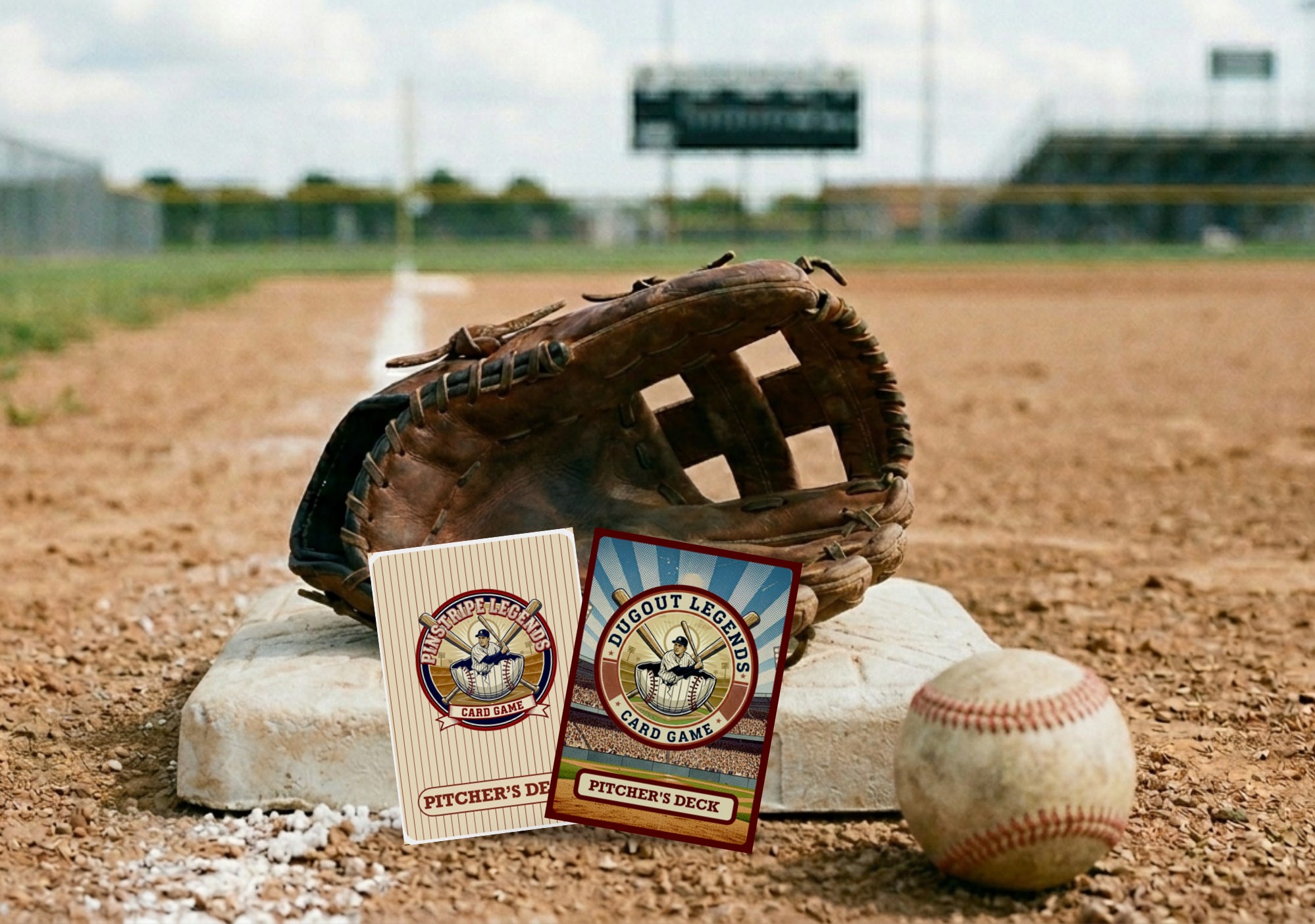
A quick pages mock-up of the name: Out with the car detailing, in with the team spirit.
Trimming the Roster: Picking the Teams
Originally, we went a little wild and designed five different teams, each with their own uniform colours: red, blue, yellow, black, and green.
The kids quickly stepped in as our voice of reason: “Dad, we can’t have five different teams, that’s way too many!” So, we held a vote to see which colours we loved playing with the most. The winners were blue and black. The blue team became Brooklyn Baseball Club, and the black team became the Aces (featuring a sleek jet-black uniform that is easily my personal favourite).
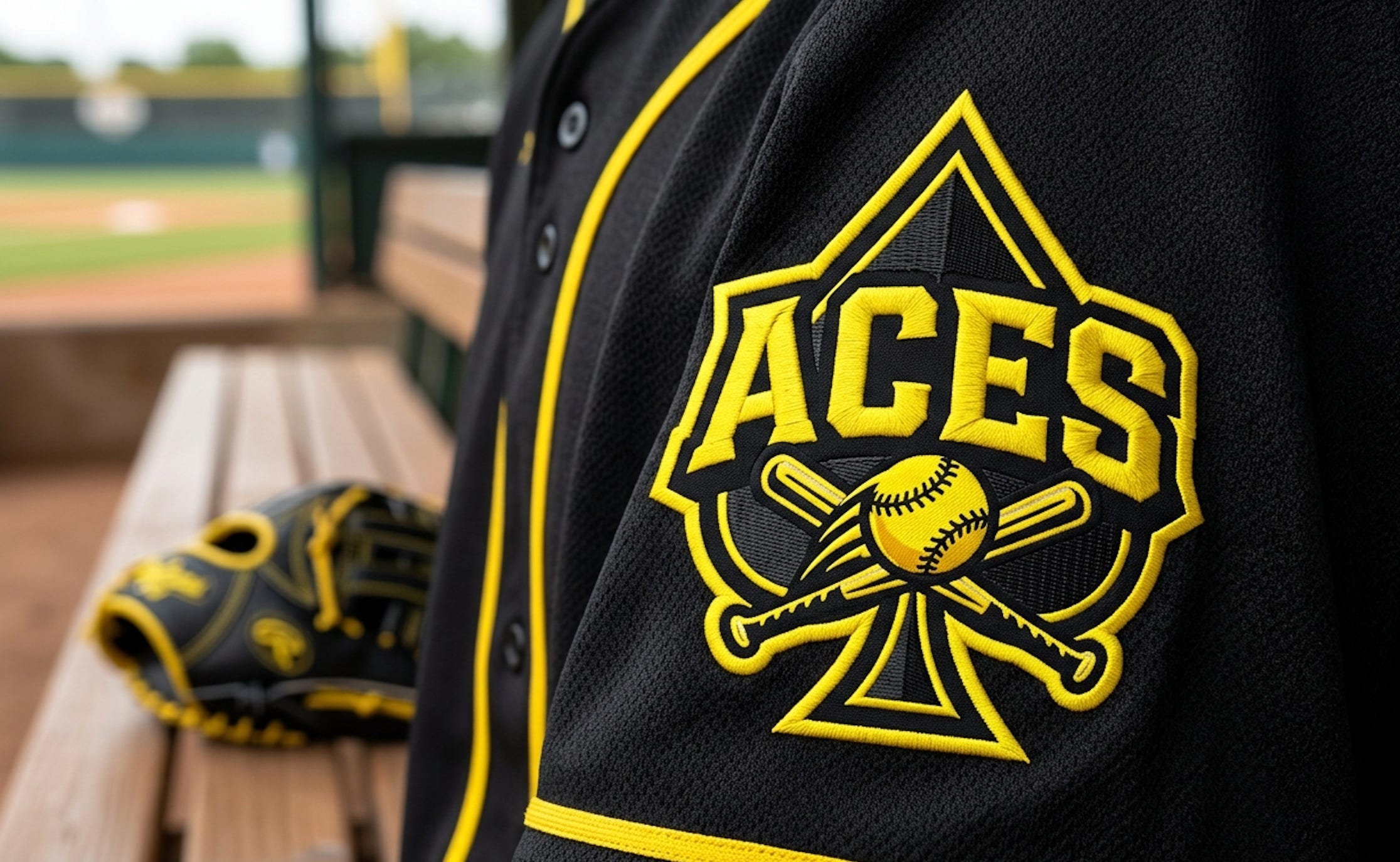
Always my favourite card suit, now my favourite completely made up baseball team, GO ACES!
However, when looking at our manufacturing templates, we realized we had just enough blank space left over for a third team. Enter the green team! The Oaks. Having a third team in our current prototypes is fantastic because it allows for three-player playoff games. We’d love to introduce more teams as expansions down the road, but for now, this three-team roster is a perfect fit.
Shrinking and Expanding the Field
The board itself underwent a massive transformation. Early on, we thought Dugout Legends should be a travel game. I wanted a board so compact it could fit inside a standard deck of cards. We engineered this elaborate, thin paper board that cut and folded out to six times its size. We even experimented with a fabric board, and a modular “puzzle piece” board inspired by our family game nights playing Pebble Rock.
But as we play-tested, we realized a hard truth: the board plays a fundamental role in the strategy of this game, and it needed to feel substantial. That brought us back to a traditional stadium layout. And as I’ve shared before, a meeting with a good friend, and a later “aha!” moment inspired by a game called Cat Crimes led us to reverse-engineer a flat board into our current Raised Stadium prototype.
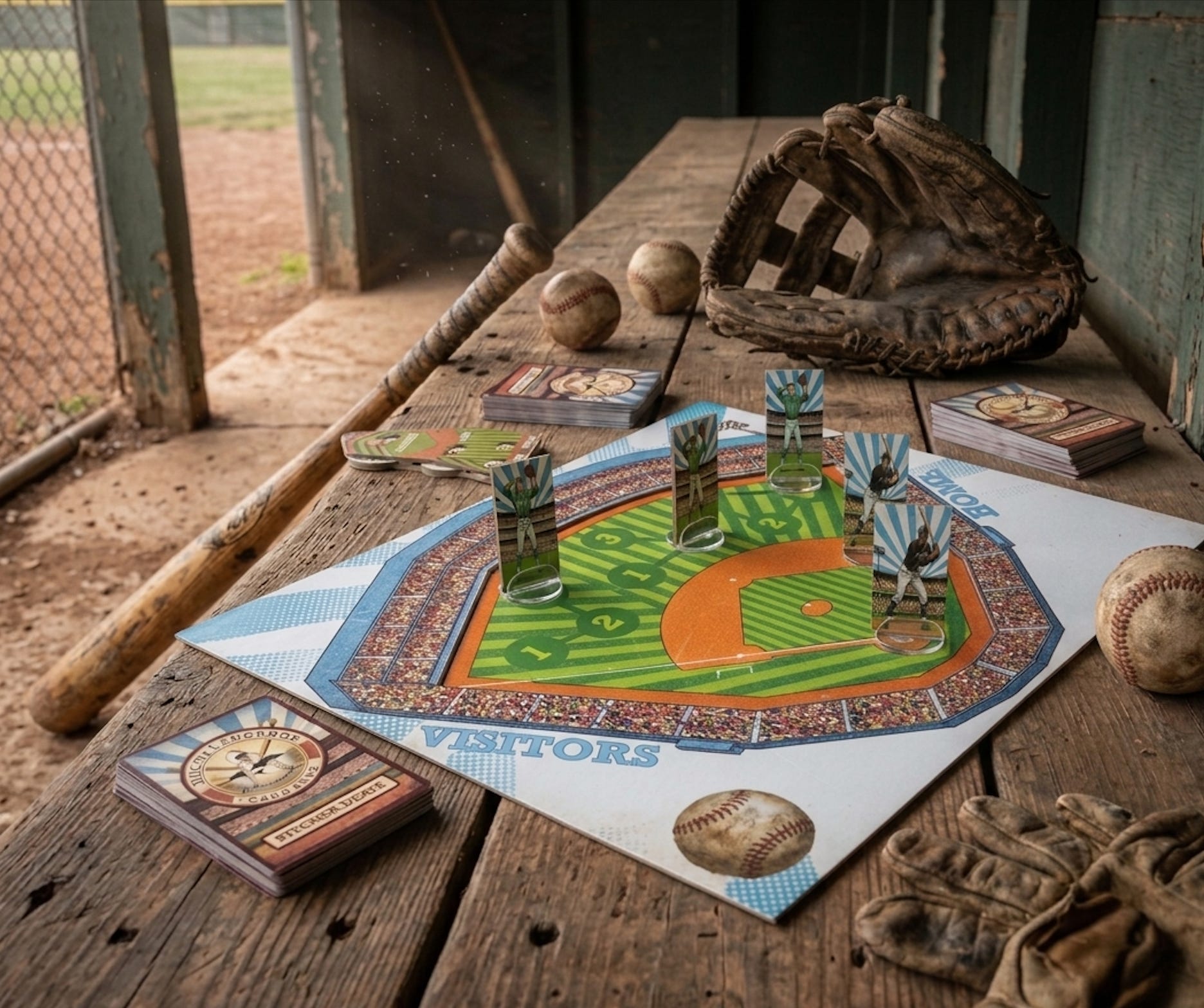
The ‘current’ layout of our raised stadium board, might have to change it down the road but right now, we love it.
The Canadian Tire Breakthrough: Building a DIY Umpire Counter
Our latest major breakthrough happened just recently, and it solved one of our biggest play-testing headaches: tracking the score.
In our first prototypes, we had a simple, flat scorecard. Players used tiny die-cut baseballs to slide along a line to track balls, strikes, outs, and innings. It worked okay for adults, but with kids? One little bump of the table and suddenly nobody knew if it was the 3rd inning or the 9th, or if the batter had two strikes or a full count.
Around this time, the kids started playing softball and T-ball. I was building a batting tee for my son and needed some materials so I walked down to Canadian Tire and thought I’d see how the professional ones were made. I found a great one for $24.99 (which saved my entire afternoon!), but right next to it on the shelf was a little plastic umpire counter, the classic handheld device with tiny wheels that umpires click to track balls, strikes, and outs.
I stared at it and thought, “This is exactly what our game needs.”
Buying plastic counters for every game box was way too expensive for a self-funded project, so we decided to build our own out of the exact same materials as the game.
Using our die-cutter, we stamped out circular wheels from our trusty cardboard cake boards. We printed the numbers, secured the wheels in place with pins, and boom, we had a fully functional, spinning DIY Umpire Counter built right into the game.
It completely solved the bumped-table problem. (We did accidentally print the “balls” wheel spinning backward, making it a bit counter-intuitive, but hey that’s the beauty of handmade prototypes! It’s an easy fix for the next batch).
The True “Win” of this Journey
We are finally reaching a point where the adjustments we are making are getting smaller and smaller. The core game is locked in, it’s balanced, and it’s incredibly fun. If this game takes off, we can look at adding more flashy elements down the road, but right now, we have a final product we are immensely proud of.
We’ve pulled our hair out a lot over the last few months, but we’ve loved every single second.
The greatest reward hasn’t just been the game itself; it’s watching my kids fall completely in love with the sport. Growing up, I didn’t have that deep connection to baseball, softball, or T-ball. Diving into this world alongside my kids and watching them naturally learn the history and strategy of the game has been incredible.
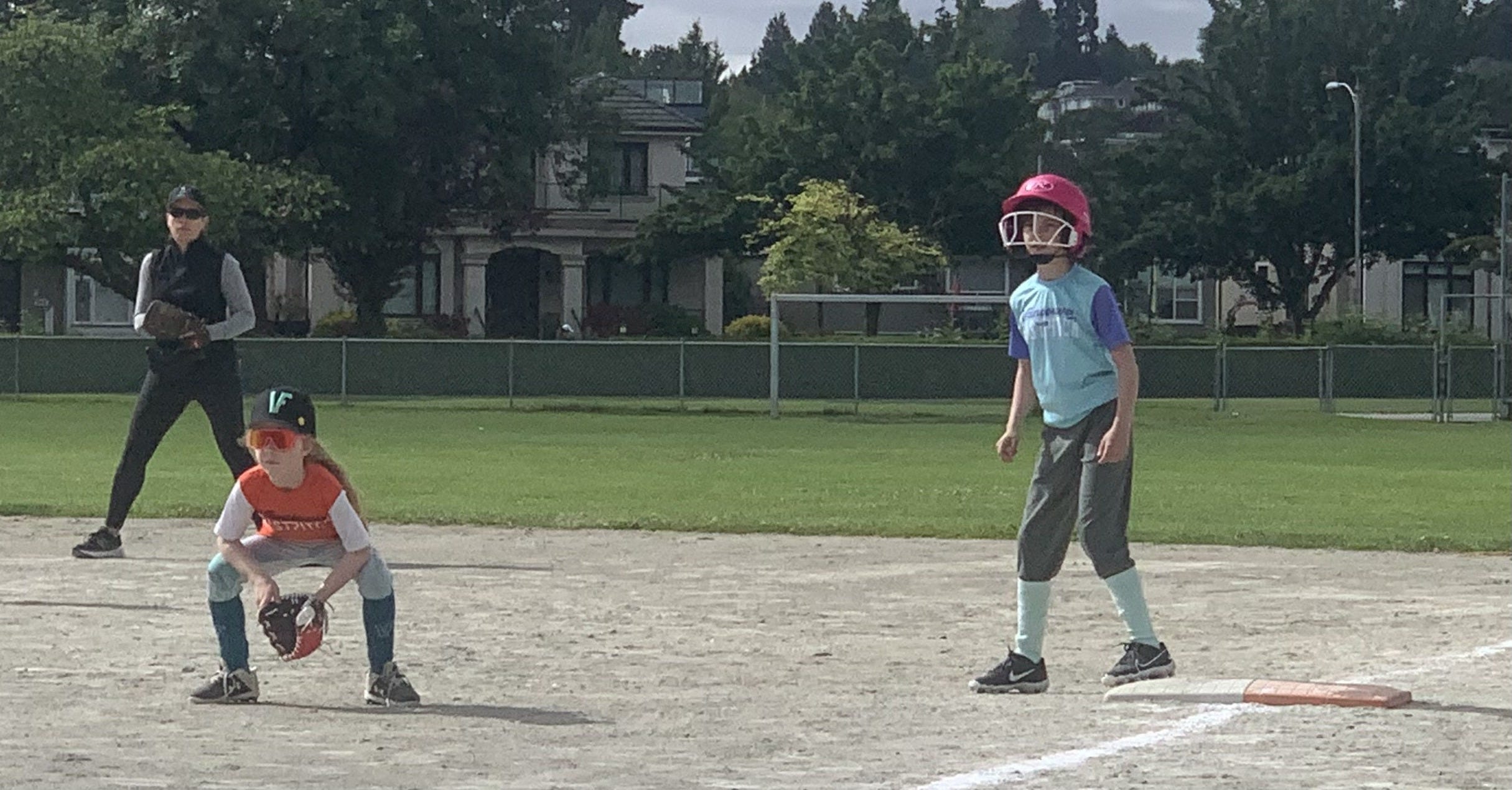
Our girls facing off against each other, this past season. Happy to see them cheering each other on.
More than anything, I hope they walk away from this kitchen-table assembly line with a lifelong lesson: Anything you can hold in your imagination, you can create in the real world through hard work, ingenuity, and sheer persistence. Roadblocks and mistakes aren’t stops signs, they are just invitations to build a better umpire counter.